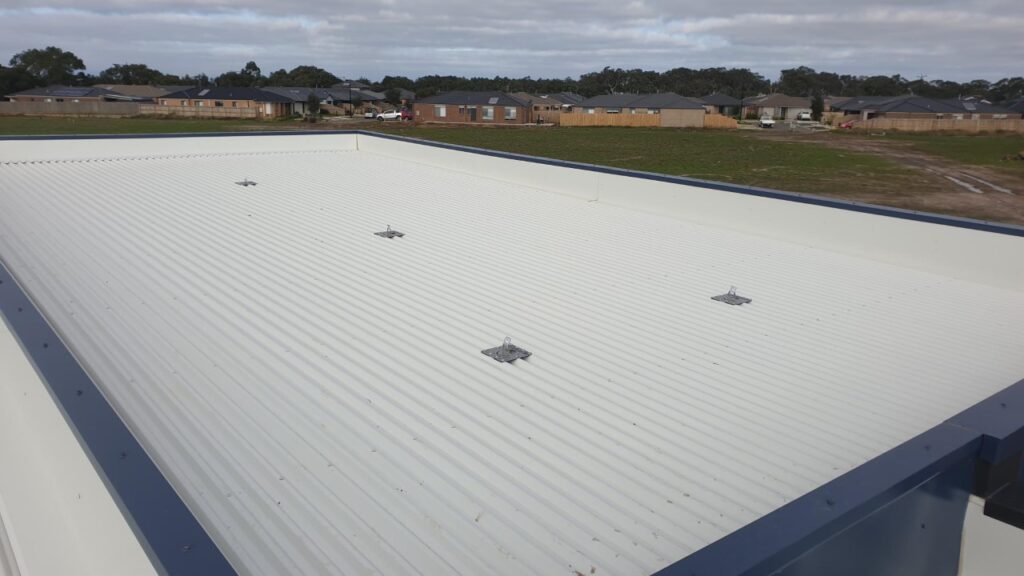
Lightweight roof structures for commercial and industrial buildings have gained significant popularity in recent years. These innovative systems offer numerous advantages, including cost-effectiveness, energy efficiency and ease of installation.
However, lightweight roof structures didn’t initially account for the load requirements of single point harness anchors (15kN). This raises key safety considerations for individuals working on such roofs, underlining the crucial role of fall arrest applications.
The relationship between lightweight roof structures and fall arrest applications emphasises the importance of stringent testing of all anchor points to ensure compliance with AS1891 and AS5532 standards. Having the correct anchors installed can mean the difference between worker safety, and an avoidable tragedy.
Considerations of lightweight roof structures
Lightweight roof structures are constructed primarily of robust yet lightweight materials like aluminium, composites, or lightweight steel like Truecore.
Workers undertaking maintenance or installation on lightweight roof structures rely on the effectiveness of single point harness anchors for fall arrest applications. The AS1891 and AS/NZS5532 standards outline the specific requirements for the manufacture and performance of these anchors. Notably, the AS/NZS5532 standard mandates each anchor to withstand a load of 15kN for 3 minutes in any direction applied. This ensures that the anchor can bear the sudden weight of a falling worker without failure.
Specialists in roof anchor point design, installation, inspections & certifications, RISSafety understands that a high quality system for roof anchor points is critical in ensuring the safety of anyone working on roofs.
RISSafety are renowned for their unwavering commitment to designing, supplying and installing roof safety products including roof anchor points. The entire range not only meets but exceeds Australian standards, especially AS/NZS5532, and are rigorously tested on current real-world applications.
Peace of mind is guaranteed thanks to the fact that all external components are made of marine grade stainless steel and designed to ensure there is no deformation under normal use. The anchor points also have in-built load absorption capabilities to minimise impact to a structure in the event of a person experiencing a fall and can be used in fall arrest or fall restraint applications.
The importance of compliance
Adhering to Australian standards not only complies with the law, but also ensures the protection of individuals at risk when working on roofs. Given the unique design of lightweight structures, it’s crucial to test all anchor points on the new designs to guarantee compliance with both AS1891 and AS/NZS5532. Regular testing and inspection ensure the reliability of the anchors and their continued effectiveness in protecting lives.
RISSafety’s single point harness anchors are rigorously tested on a variety of applications including innovative lightweight structures and blue metal battens, areas where other providers may not tread. This proactive approach to testing on emerging structures ensures RIS is not just reactive but prepared for the evolving landscape of construction.
As the industry continues to innovate with new lightweight roof structures, it is paramount to prioritise safety. Rigorous testing and continued compliance to safety standards including AS1891 and AS/NZS5532 are essential. Leading the industry, RISSafety’s exemplifies a commitment to safety in this era of construction innovation, ensuring that their fall arrest applications are reliable, effective and future-focused.
Builders, building owners and PCBUs should always request confirmation from their height safety provider that the anchor point has been tested on the specific lightweight structure applicable to their site. Need help? Get in touch: as an Australian-owned business with over 55 years’ experience in height safety, we are Australia’s height safety leader.


