The Model Work Health & Safety Regulations stipulates that every business must be able to demonstrate that it has attempted so far as is reasonably practicable, to minimize risks to safety and that to the extent that safety measures are implemented that these are regularly reviewed. Working at heights is classed as a high risk activity and is a major contributor to industrial accidents and deaths.
The Model Work Health & Safety Regulations are supported by industry Codes of Practice. The new prime Code of Practice for working at heights is “How to Prevent Falls at Workplaces” supported by Codes of Practice on “Preventing Falls in Housing Construction” and “Managing Risks in Construction Work”. The Codes of Practice are recommendations on safety issues and are not mandated. However, if they are not followed there will be a requirement to prove that the method of operation adopted provides as good – or a better – outcome. The Codes of Practice make reference to Australian Standards in the provision of guidelines for more specific hazard risks.
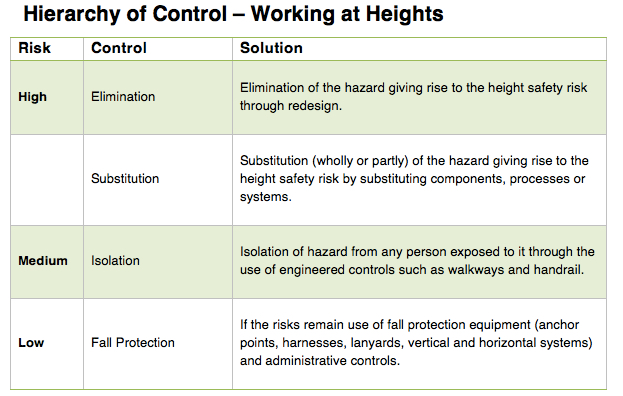
The Codes of Practice recommend that risk to safety is reviewed in accordance with the Hierarchy of Risk Control.
RIS offer services that would re-enforce that a company and its officers exercised due diligence and took all steps reasonably practicable to ensure the health and safety of workers. These services include:
For existing height safety operations – An independent specialist opinion – not dissimilar in concept to the role of an external auditor – on existing operational height safety systems.
For existing or new operations – Complete site audit and risk assessment including the full application of the Hierarchy of Control to minimise the risk to workers.
RIS have the in-house capability to design and supply specialist engineering controls such as walkways and guardrails as well as the supply and installation of the correct safety equipment (safety lines, full body harnesses, connectors etc.). This service includes the implementation of any required work method statements and other administrative control including the training and certification of operators.
For ongoing support – The long term maintenance of equipment and systems through regular inspection and recertification as defined in Australian Standards. This extends to the testing and recertification of operators.
Where there are working at height issues, companies that are working close partnership with height safety specialists such as RIS are clearly able to mitigate the risks to the Company and its officers under the new harmonised Work Health and Safety Regulations and to demonstrate the application of their duty of care to its employees.
Contact RIS to discuss the unique Strategic Partnership Programme (SPP) to protect those required to work at height in your operation.